Showing posts with label Gold Foliage. Show all posts

Monday, February 08, 2016

Golden Bleeding Heart

 
Golden Bleeding Heart
Dicentra spectabilis 'Gold Heart'
(dy-SEN-truh) (speck-TAB-ih-liss)
Fumariaceae

This plant is always a treat to see in the spring. It exhibits a modern twist on an old classic. The color of the foliage is a little variable, which I haven’t been able to figure out if that is related to parentage or the amount of light it gets in the garden. It’s handsome even when it is in full chartreuse shady glory. The flowers are large and traditionally colored.


Sunday, November 11, 2012

Constellation Dogwood Tree


Flowering Dogwood Tree
Cornus x rutgersensis 'Constellation'
(KOR-nus)
Synonyms: Rutcan


Sorry for the sporadic updates on this blog. My new job has become one of disaster relief for the gardens at the new estate. There have been a lot of tough calls on what to save and what not too. Of all the plants on the place the mature White Pines and the Lacebark Elms bore the brunt of nature's fury the most. The main tree allee of Elms was almost totally ruined but plans to replant are already being made. The big, heavy, wet snow was almost more devastating then the hurricane. The snow seemed to affect more plants than the winds did. Also of note was the havoc wreaked on the mature Holly collection. The really big Hollies made it ok but the smaller ones had a lot of damage.

Today's Flower is a special dogwood tree. It was developed by Dr. Elwin Orton of Rutgers University as a cross between our native Dogwood (Cornus florida) and the Oriental Dogwood (C. kousa). It combines to of my favorite trees. We got a couple of specimens at the old estate very early after their release (1988) and they have turned into handsome small trees. They grow great foliage but didn't seem to start blooming for a long time. I am not sure if this is indicative of the species or just the conditions mine were located in. They lack the fruit of Cornus kousa and bloom slightly later.


Norway Maple
Acer platanoides 'Princeton Gold'
(AY-ser) (pla-tan-OY-dees)

Kind of on the same note here is another tree developed in New Jersey. It is really a bright accent in the garden and should be used with care.

Friday, April 13, 2012

Mellow Yellow Spirea


Mellow Yellow Spirea
Spiraea thunbergii 'Ogon'
(spy-REE-ah) (thun-BERG-ee-eye)


This shrub is forming a nice patch after being transplanted around the yard several times. Every move has set it back a little bit but I think it has finally found it’s home and is happy. The white flowers are set off nicely against the bright golden foliage this time of year. Later the foliage color fades a little but still provides a great gold accent in the border.

Well I am all set for my gig on Saturday thanks to Chris at Hot Rod 6 Strings. He has been working on my guitars for years and I have always wanted to buy one of his custom guitars since such care and love goes into their creation. Maybe some day but for now he is providing expert help on the modification and set up of my dusty old guitars. He is the first person to take the neck off my 1957 Fender and found it dated 5-57 (all old Fenders are dated on the neck and electronics). He set up the whammy bar, which is more technically known as a tremolo arm. It's a fun part of an electric guitar that is a metal lever attached to the bridge of an electric guitar, used to vary the pitch of a played note. He also redid the electronics on my new guitar adding a tone control and toggle switch for selecting the pickups. Everything was done great at a fair price and in my quick time frame.

Friday, February 04, 2011

Golden Feathers Colorado Spruce


Golden Feathers Colorado Spruce
Picea pungens 'Golden Feathers'
(PY-see-uh)

I saw this unusual tree at a nursery last year. It would have probably made it into my cart except they wanted almost $500 for a 4-foot tall specimen. Now I don’t mind paying that much for a tree but I need to know about it first and it has to be something that really has a use.

‘Golden Feathers’ is a selection from a seedling discovered in 1960. The new growth is bright yellow that fades to a chartreuse color and then turns green. The new growth color lasts about three weeks (which is kind of short). It turns into a large tree of about 45 feet tall.


We have made it to Southern Florida and are enjoying warm humid temperatures and some actual outdoor flowers. I will be prowling around the grounds of this hotel with my camera in a little while before heading off to Key West.

Wednesday, November 24, 2010

Monday, May 24, 2010

Sweet Kate Golden Spiderwort

Golden Spiderwort
Tradescantia x andersoniana 'Sweet Kate'
(trad-es-KAN-tee-uh) (an-der-soh-nee-AH-na)

‘Sweet Kate’ has been a real pleasure to have in the garden. Contrary to my experience with most other Spiderworts this one seems to form more of a clump than a sprawling mass. The color combination of the purple flowers with the gold foliage is eye catching and I like it better than I thought originally. This plant is located with a little shade and it almost glows when the light is hitting it right. If it gets a little tired looking later in the season a quick haircut will refresh it.

Spiderwort is considered a weed by a lot of gardeners for good reason. It can become invasive but 'Sweet Kate’ will have a place in my gardens anytime. The little bit of orange in the background of this pic is from a giant Exbury Azalea that is totally covered with blooms this year. All together the bed yields quite a splash of color with the combination of the Azalea and Golden Spiderwort.

Saturday, May 01, 2010

Golden Barberry


Golden Barberry
Berberis 'Golden Carousel'
(BUR-bur-is)
Synonyms: Bailsel

The flowers on this plant are almost insignificant as they are just about the same color as the foliage. They do add a little pizzazz to the plant in the spring and look nice against the reddish new growth. The red on the leaves does fade to yellow and is most pronounced during the spring. The fall color is great, like most Barberries, a good mixture of orange, red and yellow.

When I got ‘Golden Carousel’ I didn’t know too much about it except that it was $10 more per plant than the regular Golden Barberry. I now know that it is a hybrid between Korean and Japanese barberry species. The premium turned out to be worth it as ‘Golden Carousel’ has turned into a handsome shrub. Its final height is listed, as 4 to 6 feet and I have been able to keep it to 4 feet over 12 years. It has a strong vertical growth habit that makes it an interesting accent in the garden. It also appears to be deer resistant, as it hasn’t been browsed in a heavily populated area. All in all it is a nice shrub that can find its own niche in your garden lighting up a corner with its bold foliage color. Plant in full sun for best color although in part shade it still looks good with more of a lime green color.

Friday, May 22, 2009

Skywatch - Golden Dawn Redwood

Golden Dawn Redwood
Metasequoia glyptostroboides 'Goldrush'
(met-uh-see-KWOY-uh) (glip-toh-stroh-BOY-deez)
Synonym: M. gly. ‘Ogon’
Skywatch Friday

A while back I posted that I had bought this tree and didn’t know if the marketing hype had got me or it was good decision. It has worked out nicely as the tree has already grown a couple of feet and is starting to shed it’s ‘nursery' shape with a nice branching structure. Its color is stunning and even in the fall the needles turn a nice rusty brown before falling off. It is a Deciduous Conifer. There aren’t too many of those around and I can only think of Larches (Larix), Dawn Redwood (Metasequoia), Bald Cypress (Taxodium) and Golden Larch (Pseudolarix). I am sure that is not a complete list.

If you click the Dawn Redwood label you can see the original picture I took of the foliage. It seems to be a very photogenic tree. I took this and the next picture with Skywatch Friday in mind. Yellow and blue is a nice combination in the garden.

I am not sure if anyone really knows how tall this tree gets. I did read 2/3’s of the size of a regular Dawn Redwood, which is still really big. Luckily I envisioned it getting real big and gave it enough space. It is growing on very wet soil and seemingly loves it.


Golden-leaved Boxelder
Acer negundo 'Kelly's Gold'
(AY-ser) (neg-UN-doh)
Synonym: Ash-leaved Maple, Cutleaf Maple, Stinking Ash

This is another golden tree growing at work. It has turned out okay and does add a chartreuse element to the partly shady area it is located in. I have seen it growing out in the open and it really does turn gold. It is nice since the inside leaves are a bright green so the contrast between the two is beautiful. Box Elder isn’t my favorite tree but some of the specialty ones are nice. There are two different variegated ones at work and both are handsome and almost dainty trees. One is 'Aureomarginatum' and the other is 'Variegatum'.

Kelly’s Gold’ gets up to 35 to 40 feet tall but mine is going to be shorter then that. Boxelder is native to a wide geographical area (it is the most widely distributed of the North American maples) and is considered an invasive species in some areas. It can grow on almost any soil type. It is extremely cold hardy.

Visit Sky Watch Friday for more skies around the world.
SkyWatch Friday Home Page

Friday, June 13, 2008

Golden Mountain Cornflower


Golden Mountain Cornflower
Centaurea montanaGold Bullion'
(sen-TAR-ee-uh) (MON-tah-nuh)

There was recently a post on ‘Amethyst in Snow’, which is another cultivar of Centaurea montana and I thought that one was eye catching. This flower was pretty amazing to me. It is not for everyone, I am sure, but having a small patch of these would be fantastic.

The Mountain Cornflower doesn’t require a lot of care to grow. The one thing they don’t seem to like is wet feet in the winter. Other than that they seem to happily grow just about anywhere. With ‘Gold Bullion' and a lot of other gold foliaged plants you are going to want full sun for the best leaf color.

The name Centaurea comes from Greek mythology. Chiron the centaur was said to have used the flower to heal the wounds from one of Hercules’ poisoned arrows.

Thursday, February 07, 2008

Golden Nellie R. Stevens Holly

Hybrid Holly
Ilex x cv. 'Gold Nellie R. Stevens'
(EYE-leks)

One of things I enjoyed at Planting Fields was their huge Ilex collection. Both in the scope and size of the plants. This cultivar is one type I had never seen before, and realize that it is not for everyone. The regular or normal Nellie Stevens Holly is a beautiful shrub or tree but it doesn’t grow well in my part of Connecticut. I would say about 6 out of 10 winters it is severely leaf burned and it sustains some damage 8 out of 10 years. Even though mine are planted in a sheltered location the constant winter defoliation has been taking its toll. It doesn’t actually kill the tree but makes more of a semi-evergreen, which kind of defeats the purpose of having a Holly. It seems these problems also effect the berry production as I have only had a few scattered berries in the 18 years I have been growing mine even though there are plenty of males around.


Now on Long Island they seem to thrive and are not as affected by the winter. They can attain a height of 15 to 25 feet (or more) and get a large spread. It can be quite vigorous and adaptable, growing several feet in one season. Although many books list it being hardy in USDA Zone 6 I would have to add that it is root hardy but does much better in Zone 7. It is a hybrid between I. cornuta x I. aquifolium and I couldn’t find any references to the gold cultivar.

Yellow berries on American Holly Tree (Ilex opaca f. xanthocarpa)

I have been trying to get a picture of the yellow berried form of the American Holly Tree for a long time. Mine don’t seem to get a great crop of berries and are located in a dark corner of the garden, hence difficult to shoot pictures of. I didn’t do much better at Planting Fields with this picture but they had a lot of different specimens that were loaded with yellow berries. So, I am posting this picture of Ilex opaca f. xanthocarpa to get it out of my system. This will hopefully allow me move on and get that picture of Lily of the Valley flowers I have been trying to take forever.

There several yellow berried cultivars of American and other Hollies. I think they add a little spice to a Holly collection.

Saturday, July 14, 2007

Golden Bluebeard (Caryopteris x clandonensis 'Worcester Gold')


Golden Bluebeard
Caryopteris x clandonensis 'Worcester Gold'
(kar-ee-OP-ter-iss) (klan-don-EN-sis)
Lamiaceae (lay-mee-AY-see-ay)
Synonyms: Blue Mist, Blue Mist Spirea

I am not sure if you are suppose the cultivar name like they do in Massachusetts, ‘Woo-Ster’. This plant failed a couple of times for me until I found out it needs good drainage to survive. Since I have figured that out it has been happy in my garden. It needs sun to have the best foliage color, which is more chartreuse then golden. It often fades to a lime green later in the season and in more shady areas. Which I know to a lot of people who use gold foliage plants is an undesirable trait. Personally I don’t mind if a plant does that but I guess it could screw up someone’s design if it changed color. The flowers are a great hue of blue and are long lasting. They attract bees and butterflies in good numbers. The foliage is also aromatic and it has shown good deer resistance here in Connecticut and Westchester County in New York.


Another thing I have learned about this plant is not to cut it back too early in the spring. What appears to be dead will sometimes spring to life. You can treat it as cut back shrub or a semi-woody perennial if you want but I prefer just enough trimming to keep it neat. In USDA Zones 5 and 6 it can sometimes be burned down to the ground in a bad winter. Don’t despair, it is root hardy and should send up new shoots. Claude Palmer of St. John’s Nurseries discovered this cultivar in Worcester, England.

I am a big fan of the ‘regular’ Blue Mist shrub. It has grayish-green foliage and the same flower color. Some of the newer cultivars even have darker blue flowers. I usually sneak a couple of them into designs because they give color in the late summer.

Thursday, October 26, 2006

Himalayan Ivy Vine


Himalayan Ivy Vine
Hedera nepalensis var sinensis ‘Marble Dragon’
(HED-er-uh) (nap-ahl-EN-sis)

I am glad this picture came out with kind of a soft focus because that is exactly the effect this ivy had. It was climbing up the side of the Alpine House (that is what I call it anyway) at Wave Hill Garden in the Bronx. When I Googled this plant there wasn’t too much information. The older leaves had various green markings and tones to them but it was the gold new growth that attracted me. The vines had crawled up the side of the wall and spilled onto the top of a window sill.

I have almost all my plants in the ground but I haven’t been able to locate a Bush Clover (Lespedeza thunbergii) locally. I guess I am going to have to mail order for it.

Sunday, October 08, 2006

Golden Larch (Pseudolarix kaempferi)


Golden Larch
Pseudolarix kaempferi
(soo-doh-LAR-iks) (KAMP-fer-ee)

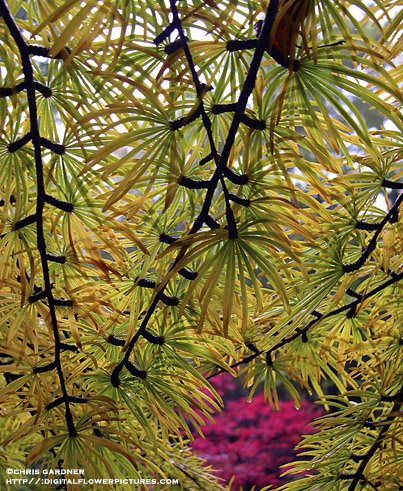
The name of this tree can be a little misleading. First, it isn’t a true Larch and second it is green during the summer and turn gold during fall. It is a handsome tree for the large garden. It is more closely related to a Fir tree than a larch. It is a deciduous conifer, which makes it kind of an oddball. I am sure there are others but Bald Cypress (Taxodium distichum), Dawn Redwood (Metasequoia glyptostroboides) and the Larches (Larix sp.) are a few deciduous conifers that I have grown. This tree is easy to grow and has a wonderful soft appearance during the season. The real show is the fall color. It doesn’t seem to last too long but is glorious when it is happening. This specimen is growing near the shore of a pond but about six feet above the water line. That hasn’t seemed to slow it down, as it is getting fairly large. The spot of red is a group of Sourwood trees (Oxydendrum arboreum). They are a great late summer flowering tree with superb fall color. I have been told that you should always buy Sourwood Trees when they are in color too make sure you get a good one. It certainly worked with this group.

Friday, September 29, 2006

Golden Japanese Forest Grass (Hakonechloa macra 'All Gold')


Japanese Forest Grass
Hakonechloa macra 'All Gold'
(hah-koh-nee-KLO-uh) (MAK-ruh)

This plant actually got me in a little trouble when I accidentally picked it up when I was looking for it’s gold with a green stripe cousin Hakonechloa macra 'Aureola'. I ended up planting it anyway and it turned out for the better. I prefer ‘All Gold’ for edging along a shady walk or patio. It seems a little smaller, daintier and a little more upright growing. The larger 'Aureola' is better for covering large areas as groundcover but is also nice planted as accents. There have been some reversions on some of my older clumps of 'Aureola' while the ‘All Gold’ has really kept its color.

This plant seems to rightly gaining in popularity. It seems a little expensive but I think that is because it is slow to expand. You get good coverage without rampant growth.

Tuesday, August 29, 2006


Golden Foster’s Holly
Ilex x attenuata 'Sunny Foster'
(EYE-lecks) (at-ten-yoo-AY-tuh)

I saw this one at Polly Hill Arboretum on Martha’s Vineyard. Personally I love gold foliaged plants but I guess they are not for everyone. I think they look great as an accent and if used judiciously and sparingly they can add some drama to the garden. I haven’t grown this one personally so I am relying on information that I researched.

‘Sunny Foster’ was a leaf mutation of ‘Foster No. 2’ discovered in 1964 at the U.S. National Arboretum. The original ‘Foster’ Holly was part of a group of hybrids between Ilex cassine x Ilex opaca. It was released in March, 1982. It has nonmarginal variegation of yellow in the upper third of the leaf that deepens during the season. Planting in full sun intensifies this. The plant at Polly Hill was almost all yellow but the hint of green added a nice touch to the appearance. This plant is hardy in Zone 7 (USDA).

I wanted to thank the staff of the Arboretum for emailing with the identification of the plants that I asked about. They were really nice to take the time. The staff was very friendly while we at the garden also.

Wednesday, August 23, 2006


Desert Sky Chinese Plumbago
Ceratostigma willmottianum 'Palmgold'
(ser-uh-toh-STIG-muh) (wil-mot-ee-AH-num)

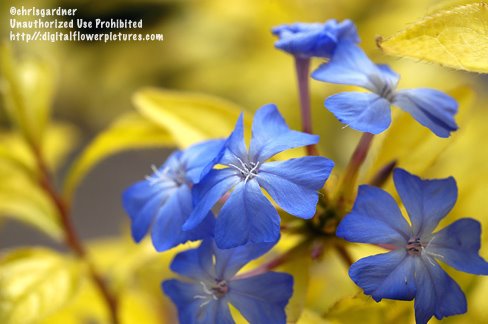
This is another gold foliage accent plant I saw on my weekend visit to Wave Hill. It was in a container and I forget what else was planted with. I think that is because this plant is so intriguing that it overshadowed the other plants. I did a little research into this plant and see it is a 2001 introduction by the British Palmstead Nursery. It is rated for USDA Zones 8-10. Most of the nursery catalogs say that ‘with protection’ it can go colder. That always makes me a little worried here in Connecticut. Our winters are way too unpredictable. I will have to ask at Wave Hill if they take it inside during the winter.

This plants appearance is stunning and sensational. I have grown Leadwort (Ceratostigma plumbaginoides) and found it to be a great groundcover. A little finicky to get going but once it does it is easy to grow. I do notice that it doesn’t emerge very early; it is one of those plants that you think is dead but later ends up looking pretty good. Like today’s featured flower it is also a wonderful shade of blue.

I almost finished the sod job today. It is a lot of work but looks nice when finished. The sod was 90% Kentucky Bluegrass (Poa pratensis) and looked great. I have never seen almost pure Bluegrass and I see that a lot of stems do have a bluish cast to them. Since it is so dry here I am going to have to water it everyday.