Showing posts with label Berries. Show all posts

Friday, September 11, 2009

Scarlet Firethorn


Scarlet Firethorn
Pyracantha coccinea
(py-ra-KAN-tha) (kok-SIN-ee-uh)
Skywatch Friday

This shot is from the archives and was found while being copied onto a new hard drive. It was taken in the Somerset area of England in November of 2005. I was still a relatively new owner of a DSLR at the time. We had great fun on the trip and this photo brought back some memories. There is a little sky poking in and it provided a nice light. I am always amazed how low the sun angle seems in England in the autumn and winter.

Pyracantha is a nice plant as long as you can keep your distance. The berries look great and the foliage is often semi-evergreen here in Connecticut. It can grow in almost any soil and doesn’t need a lot of care. There are several types available for the garden including the dwarf ‘Gnome’. It seem people often plant this a little out of place. It needs room to grow and not interact with sidewalks, doors, parking areas, etc. I have read several references where they say Pyracantha gets to 10 feet tall. I have had it grow almost twice that size when it is happy. I would definitely consider it a large-scale shrub.

Today is a grim anniversary for the United States and the world. We are playing a gig tonight at the local coffee house. At first we almost refused the date but thought it was okay. I am sure everyone is remembering the day in his or her own way. We have decided to make some music. This blog has commemorated this anniversary before.

Since this is a flower picture blog here is a picture I took yesterday of an Ivy leaf Geranium. The flower color almost matches the berries.


Visit Sky Watch Friday for more skies around the world.
SkyWatch Friday Home Page

Monday, August 10, 2009

Coral Sunset Geranium


Coral Sunset Geranium
Pelargonium x domesticumCoral Sunset
(pe-lar-GO-nee-um) (doh-MESS-tik-um)
Synonyms: Regal Pelargonium, Martha Washington Geranium

We went to Stonecrop Gardens yesterday and one of the highlights (for me) was the Geranium collection. It is an amazing garden and I would highly recommend it for touring. To me it wasn’t like a fancy botanical garden more like the sign says a “plant enthusiast garden”. The amount of different and strange plants they had was huge and they were for the most part set up informally.

While I am not trying to make excuses the light was really bad yesterday. It was pretty much dark out (like a murky twilight) and spitting rain on and off. Even with all that I did manage to get a few good flower pictures, which will be posted later in the week. This picture of the Sumac berries was taken with Ruby Tuesday in mind. I like certain types of Sumac in the garden. They aren’t all bad.


Here is a Zinnia I saw a few weeks ago and keep neglecting to post. It goes with Ruby Tuesday so here it is. The big patch of this Zinnia must have been grown from seed as there were some nice variations in the flowers.


Zinnia 'Swizzle Cherry and Ivory'
(ZIN-ya)

See more Ruby Tuesday at Work of the Poet.

Sunday, December 28, 2008

Dead Man's Fingers


Dead Man's Fingers
Decaisnea fargesii
(de-KANE-ee-uh) (far-GHEE-zee-eye)
Synonyms: Blue Bean, Blue Sausage Fruit

This native of the Sichuan province in China is not too popular as a landscape plant. Its pods are probably the best part of growing it. That color blue is just not found in too many plants. The seedpods are edible, I have been told, but from the looks and feel of the seeds you wouldn’t catch me putting it in my mouth. I can forego eating anything called Dead Man’s Fingers.

Decaisnea grows to about 10-12 feet tall as a multi-trunk shrubby tree. Its flowers aren’t anything special and the pinnate foliage is nice when mixed with other plants like some of the bigger Viburnums.

Here is another plant that gets nicely colored berries, Oregon Grape Holly (Mahonia aquifolium). The berries in this picture are not quite ripe but still have some of the bluish green color. This plant blooms in very early spring with fragrant yellow flowers and makes the berries soon after (this picture was taken last June). Mahonia is going to need its own post.

Thursday, February 07, 2008

Golden Nellie R. Stevens Holly

Hybrid Holly
Ilex x cv. 'Gold Nellie R. Stevens'
(EYE-leks)

One of things I enjoyed at Planting Fields was their huge Ilex collection. Both in the scope and size of the plants. This cultivar is one type I had never seen before, and realize that it is not for everyone. The regular or normal Nellie Stevens Holly is a beautiful shrub or tree but it doesn’t grow well in my part of Connecticut. I would say about 6 out of 10 winters it is severely leaf burned and it sustains some damage 8 out of 10 years. Even though mine are planted in a sheltered location the constant winter defoliation has been taking its toll. It doesn’t actually kill the tree but makes more of a semi-evergreen, which kind of defeats the purpose of having a Holly. It seems these problems also effect the berry production as I have only had a few scattered berries in the 18 years I have been growing mine even though there are plenty of males around.


Now on Long Island they seem to thrive and are not as affected by the winter. They can attain a height of 15 to 25 feet (or more) and get a large spread. It can be quite vigorous and adaptable, growing several feet in one season. Although many books list it being hardy in USDA Zone 6 I would have to add that it is root hardy but does much better in Zone 7. It is a hybrid between I. cornuta x I. aquifolium and I couldn’t find any references to the gold cultivar.

Yellow berries on American Holly Tree (Ilex opaca f. xanthocarpa)

I have been trying to get a picture of the yellow berried form of the American Holly Tree for a long time. Mine don’t seem to get a great crop of berries and are located in a dark corner of the garden, hence difficult to shoot pictures of. I didn’t do much better at Planting Fields with this picture but they had a lot of different specimens that were loaded with yellow berries. So, I am posting this picture of Ilex opaca f. xanthocarpa to get it out of my system. This will hopefully allow me move on and get that picture of Lily of the Valley flowers I have been trying to take forever.

There several yellow berried cultivars of American and other Hollies. I think they add a little spice to a Holly collection.

Monday, November 26, 2007

Late Berries

Pyracantha coccinea berries in afternoon sun.

Late Berries

I went out looking for a few pictures yesterday. Obviously there isn’t much left out in the garden. I decided to take a few berry pictures as I feel that is something I am not very good at and haven’t had a lot of success in the past. Most of the berries were on their way out and the birds were at work eating the Crabapples and other fruit.

These were the best I could come up with:

The first picture is Scarlet Firethorn, Pyracantha coccinea (py-ra-KAN-tha). It is a shrub that can be very difficult to work around. It isn’t called Firethorn for nothing, they feel like fire when they stick in! It is a nice shrub for certain areas and privacy screens but be careful where you plant it in the garden. I think it looks best as an espalier. The ability to withstand drought and neglect, a fast growth rate, white flowers and colorful berries are a few of the reasons to plant Pyracantha. It can even grow in shade although you won’t get as many berries.


This tree is another plant with vicious thorns. I take care of several types of Hawthorne and they are just a bear to prune, downright dangerous actually. The Cockspur Hawthorne (Crataegus crusgalli) is a nice little tree that grows to about 18 feet tall and 20 feet wide. Its white flowers in the spring are followed by very glossy foliage for the summer with these fruits in the fall and winter. Another plant to be careful with the site you plant it on. The flowers have a slightly unpleasant odor so it should not be located near the front walk or next to a terrace or patio. If you are not using one of the thornless types don’t plant it near where children will be playing.


I am not sure what Viburnum this is. It is one of the few I have seen with yellow berries. The Estate has a fairly large Viburnum collection and I think I will try and add a yellow-berried type to it next year. This one was planted amongst some of the red-berried Viburnum and it was a quite striking combination. I took this photo in a parking lot and couldn’t get a good angle on the combination shot.

Saturday, November 24, 2007

White Beautyberry

White Beautyberry
Callicarpa dichotoma 'Albifructus'
(kal-ee-KAR-puh) (dy-KAW-toh-muh)
Synonyms: var. albifructus

I think I got the name of this plant right. I wasn’t sure if it was this one or Callicarpa japonica 'Leucocarpa'. C. dichotoma is hardy to USDA Zone 7 and the japonica is hardy to Zone 5. I haven’t seen either growing in Connecticut before but think I will try to get the hardier one as I garden on the colder edge of Zone 7. Some Zone 7 plants will work but eventually we get a really cold winter and that is that for them. Purple Beautyberry is one of my favorite fall shrubs as you just don’t see that particular shade of purple in the garden much.


These picture was taken at Skylands, the New Jersey State Botanical Garden a couple of weeks ago. They had about 4 or 5 of these plants and it made for a beautiful cluster of shrubs. If I had known that there were two types of White Beautyberry I would have investigated a little further trying to get an identification. If anyone knows any differences between the two plants please chime in.

Sunday, November 04, 2007

Sparkleberry Holly


Sparkleberry Holly
Ilex x ‘Sparkleberry’

This is an interesting deciduous Holly that I have been growing for several years. I always thought it was a cultivar of Winterberry Holly but after looking it up I found out that it is a cross between Finetooth Holly (Ilex serrata) and our native Winterberry or Black Alder (Ilex verticillata). According to my research ‘Sparkleberry’ was the result of a controlled cross between the two plants in 1961 by William Kosar. It came out of the National Arboretum’s plant breeding program with the desire to have the I. serrata’s heavy fruiting characteristics and the adaptability and larger berry size of the Winterberry. From my point of view they were extremely successful.

I have my plants on the edge of the woodland in full sun. They can also tolerate part sun and very wet sites. Although you will get more berries when they are planted in full sun. I don’t have the male pollinator ‘Apollo’ that was developed at the same time. I do have several other male winterberries and have not had a problem with getting fruit on my ‘Sparkleberry’. It just requires a male of either species. These shrubs do get up to about 12 feet tall with a fairly large spread so they need a little room. I prune mine lightly whenever they need it to maintain a nice shape but basically they are very low maintenance. They are hardy to UDSA Zone 5b.


Since when I featured the ‘Little Boo’ white pumpkins on Wordless Wednesday a lot of people wrote that they had never seen a white pumpkin before I thought I would post this image of a full sized one. I took it at the same time as the other picture. I don’t know what variety this is but it much more like a normal sized pumpkin than the ‘Little Boo’, which you can see in the left side of the picture.

Wednesday, October 31, 2007

ABC Wednesday ~ ‘Scarlett O’Hara’ Winterberry Holly


ABC Wednesday ~ ‘Scarlett O’Hara’ Winterberry Holly

Winterberry Holly
Ilex verticillata ‘Scarlett O’Hara’
(EYE-leks) (ver-ti-si-LAH-tuh)
Synonyms: Black Alder

This week brought a wealth of ‘O’ photos. I actually had a few extra that I didn’t use. Those will probably be popping up here and there over the next few weeks. I am the only one that is thinking about next week’s letter right after this post? ‘P’ should be easy. I am thinking of something already.

We pretty much wrapped up the gardening season here this week. Both Monday and Tuesday featured killing frosts. In one way I am sorry to see it go, in another it was a fairly terrible season to grow things around here. We had a late Spring, cool summer, drought in late summer early fall and all that really didn’t add up to a great growing season. I guess some plants liked the conditions and flourished and some didn’t and didn’t do well. All in all Connecticut’s climate is fairly amazing because of the amount of plants that find the conditions to their liking during the season. It is a broad based bunch that hails from around the world. This year a lot of things didn’t thrive like they have in the past. In general I would give the year a 6 out of 10 and that maybe a little generous. As a gardener though I am pretty much an eternal optimist and will be out there again next year, with high hopes.

‘Scarlett O’Hara’, which is of course named after the heroine from ‘Gone with the Wind’, is a deciduous Holly. The plant has become quite popular and there are numerous named cultivars available. I hadn’t seen this one before but have been growing some of the others like ‘Winter Red’, ‘Sparkleberry’ and the smaller growing 'Cacapon' and ‘Red Sprite’. The cultivars are better than the species in almost every case. This Northeastern United States native likes moist soil and can grow in wet areas. It also can grow on drier soils but I like to use it in tough areas. The striking berries are really showy when the leaves fall off and the birds like them.


Oxalis vulcanicola “Molten Lava’

This ‘O’ is growing at work in the Conservatory. It is a funny little plant that flowers from time to time. The foliage color is interesting and it doesn’t seem to need much care. I just found out the foliage gets a deeper and richer color in the sun. I will have to move it. If you want to know more about the Wood Sorrels refer to this page of Oxalis.org

and the Wikipedia page on Oxalis


This last ‘O” is for ocular. I took this picture at a local nursery. When I went up there last week they already had the Christmas stuff out!


Here are some of the other blogs that are participating in ABC Wednesday. If you want to join let me know and I will add your link. I took out a few people that haven’t been posting the last couple of weeks. If you want to get back on the list leave a comment. We also have some new people and to them welcome!


Oh yeah, I am sure someone else though about this, ‘O’ is for Orange.

Monday, November 20, 2006

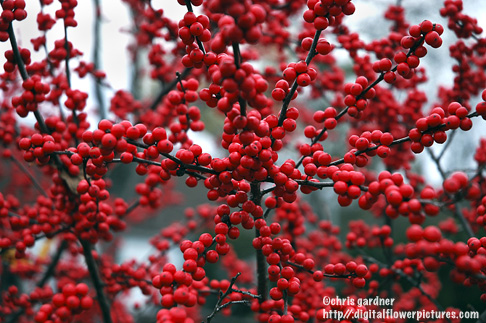
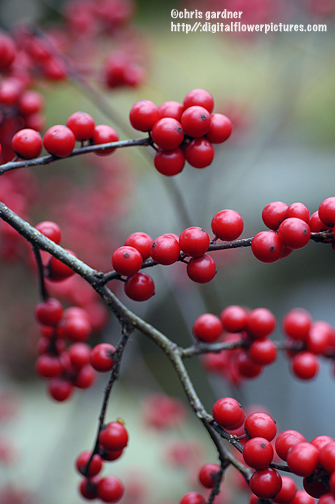
"Winter Red' Winterberry Holly


Winterberry Holly
Ilex verticillata 'Winter Red'
(EYE-lecks) (ver-ti-si-LAH-tuh)

My Winterberry Holly never seem to quite end up with as many berries as this specimen I saw at Rosedale Nurseries in Westchester County. I am not sure why, maybe because some of them are growing in part shade. Even if you don’t have this many berries it is still a nice plant to grow. On 10/21 I posted a shot of ‘Winter Gold’ Winterberry and they always seem to have a heavier crop of berries than my ‘Winter Red’. This is probably related to something I am unintentionally doing and I haven’t been able to figure it out.

I am not looking forward to this week. I have six days of work planned and only three days to do it. Last night when I took the garbage out there was a rain and snow mixture, and that doesn’t bode well for all the clean up and other work I have to do. I guess it is time to pay for all those nice temperatures we have been having the last couple of weeks.

Friday, November 17, 2006

Possumhaw (Ilex decidua ‘Warren’s Red’)


Possumhaw
Ilex decidua ‘Warren’s Red’
(EYE-lecks) (dee-SID-yoo-uh)

This plant never fails to deliver a good crop of brightly colored berries. It is not exceptional during the summer but it isn’t bad looking either. ‘Warren’s Red’ was discovered as a sport at Otis Warren and Son Nursery in Oklahoma City. It grows much smaller than the species. Mine has been growing at the side of a man-made pond for several years so it tolerates wet soil. It is about 5 feet tall and 4 or 5 feet wide, which is smaller than the listed size. I never have had to prune it. It is growing next to a planting of Red and Yellow Twig Dogwood that didn’t turn out the way I wanted. As a matter of fact I decided to remove them yesterday. I hope to get a few more ‘Warren’s Red ‘ to replace them. It looks similar to Winterberry Holly but seems to hold its foliage a bit longer. It seems like it gets a heavier crop of berries every year, which my Winterberries don’t always do.


(Synonyms: Possum Haw Holly, Deciduous Holly, Ilex decidua var. curtissii)

Wednesday, November 15, 2006

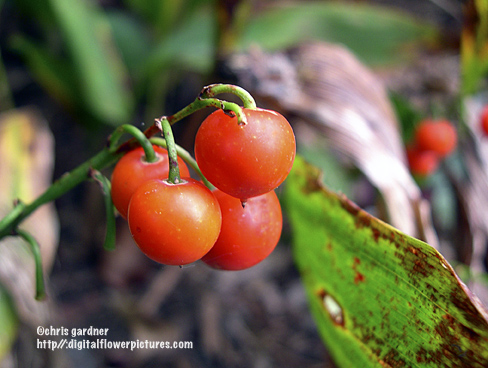
Lily of the Valley (Convallaria majalis)


Lily of the Valley
Convallaria majalis
(kon-vuh-LAIR-ee-uh) (maj-AY-liss)

Berry pictures are always a bit of a stumbling block for me. Usually the light is either too bright or too dark. I keep trying though and while I have gotten a little better there is still a long way to go. I think using a tripod might be helpful. 90% of my flower shots are handheld. Using a tripod is a little cumbersome in the garden sometimes. Take this shot; I was down on my knees as these berries were only about 6 inches tall. It is a little frustrating to keep trying a subject that isn’t cooperative but it is also rewarding when you do get the picture.

Lily of the Valley is a beautiful fragrant groundcover that can grow in sun or shade. I use it mainly in the shade, as kind of a problem solver sometimes. I have been growing the Pink Form and it doesn’t seem to multiply as fast as the white but it is an interesting novelty. I had never seen these berries before and from some research I found out they don’t always mature. They each contain one seed but the best way to propagate it is to dig some of the ‘pips’ up. Speaking of groundcovers when I was at work the other day I was looking at an area that had kind of naturalized. I had been transplanting in little bits of groundcovers and shrubs for kind of a modified woodland garden. Anyway I was looking under an Azalea and I noticed a patch of ground where Pachysandra, Myrtle (Vinca minor), Lily of the Valley and Bishop’s Weed (Aegopodium podograria), had met up. It looked like a little Carpet Bugle (Ajuga) in there too. I will be watching to see what happens. That is kind of thing that sometimes happens when, over the years, you keep layering plants in.

There are quite a few legends associated with Lily of the Valley. It has been used medicinally though all parts of the plant are considered poisonous.

(Synonym: May Bells, Our Lady's Tears, Ladder to Heaven, Jacob's Tears)

Monday, November 13, 2006

Heavenly Bamboo (Nandina domestica)


Heavenly Bamboo
Nandina domestica
(nan-DEE-nuh) (doh-MESS-tik-uh)

This plant does well in Southern Connecticut gardens. It is considered invasive by some people but doesn’t really seem to spread or seed too much around here. If you are worried about it use one of the garden types that don’t seed. It is best to check in your area for growth habit and invasiveness. It really is a low maintenance plant for these parts. The berries are probably the nicest part but the foliage is a glossy green and also is attractive. The persistent berries can last well into winter and the birds like them. My favorite time is when the foliage is still green and the red berries come out. Add a pinch of snow and that is fabulous. For people with less space try one of the dwarf types. There are also culitvars that have a deep red fall/winter color.

Saturday, October 21, 2006

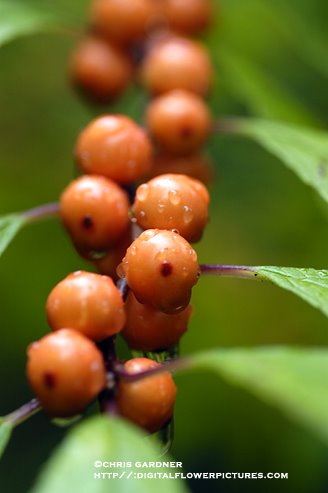
Winter Gold Winterberry Holly (Ilex verticillata 'Winter Gold')


Winter Gold Winterberry Holly
Ilex verticillata 'Winter Gold'
(EYE-lecks) (ver-ti-si-LAH-tuh)

I bought his plant as ‘Winter Gold’ although my friend swears it is sub-species of Winterberry that I have forgotten the name of. Whatever it is a great plant and adds a little zip to the Winterberry collection at one of the large gardens I take of. This plant is easy to grow and will tolerate moist to wet conditions. Most people’s first guess would not be holly because it is deciduous and spineless. I have been keeping ‘Winter Gold’ at about 6 feet though it seems to want to get a little taller. There is always a good crop of berries and the foliage remains clean throughout the season. I took pictures of some of the other Winterberry Holly that I will be posting next week.

I have to go out and see what last night’s high winds did to the gardens. Hopefully not too much but 50 miles per hour with a leaf load may have been too much. I am not sure why some of the color washes out on Blogger but these berries are a darker shade of orange!

(Synonyms: Black Alder, Michigan holly, Common Winterberry)

Wednesday, October 18, 2006

Coralberry (Symphoricarpos x doorenbosii 'Amethyst')


Coralberry
Symphoricarpos x doorenbosii 'Amethyst'
(sim-for-ee-KAR-poss) (door-en-BOH-see-eye)

The color of the berries made me take a look at this plant at the nursery. This one isn’t quite ripe as the color deepens a bit. The pastel color is very effective and the plant looked much better than the Coralberry I have been growing which is actually a different species (Symphoricarpos orbiculatus). This hybrid is supposed to be much better branching and fruiting than some of its more scruffy cousins. It was developed for the floral industry in Germany. I have to rate this one for the more advanced gardeners or people with a large woodland garden. It does seem to have some deer resistance. My Coralberry was planted in sun and now is shaded by the Tupelo Tree (Nyssa sylvatica) I planted years ago. It has finally turned into a nice specimen. The fellow I bought it from said “it’s the nicest one I have seen”, and I thought ‘yeah, sure’. I must say after taking several years to really get going the tree does have the most fabulous fall color.

It looks like peak foliage color around here this weekend. The leaves have not been their usual brilliant selves. This rain we are getting is sure going to knock a lot of the leaves down.

Synonyms: 'Kordes', Snowberry

Saturday, September 30, 2006

Chinese Dogwood (Cornus kousa)


Chinese Dogwood
Cornus kousa
(KOR-nus) (KOO-suh)


A short post today as I put the final touches on the proposal I am presenting today. The house is been recently lovingly restored and is on a beautiful piece of property. You can see from the plant list that it will be a very nice garden once planted. This list is for the heart of deer country. The Pound Ridge neighborhood is over run with deer. I am planting a mix of deer resistant species and some that we will spray with repellent during the season. Some seasonal fencing may be in order for the winter. I found that after the plants get established they are a little less appetizing to the deer.

I took this picture at a local garden retailer named Lexington Gardens. They always have some interesting plants. As I was driving away I saw this Kousa planted in the display gardens. It was literally covered with fruit. It must have been a selection or cultivar, as I have never seen such a compact heavy fruiting type like this. The tree was big but not as big as the species. A couple of the guys at work like to eat these berries but I find them disgusting.

Here is the plant list from the proposal:

2 Globe Blue Spruce (Front Door) (Picea pungens glauca 'Globosa')
2 Fastigiate Norway Spruce (Picea abies 'Cupressina')
1 Dragon Lady Holly (I. x aquipernyi ‘Dragon Lady’)
1 River Birch (Betula nigra ‘Heritage’)
1 Dwarf Laceleaf Red Maple (Acer palm. dissectum)
1 Kousa Dogwood (Cornus kousa)
1 Weeping Cherry (Prunus subhirtella 'Pendula')
1 Fastigiate Blue Atlas Cedar (Cedrus atlantica 'Fastigiata')
18 Dwarf Fountain Grass (Pennisetum alopecuroides 'Hameln')
6 Royal Burgundy Barberry (Berberis thunbergii 'Gentry')
6 Blue Mist Shrub (Caryopteris x clandonensis)
3 Tardiva Hydrangea (Hydrangea paniculata 'Tardiva')
6 Helleri Japanese Hollies (Ilex crenata 'Helleri')
3 Miss Kim Dwarf Lilac (Syringa meyeri ‘Palibin’)
9 Large Pieris (Pieris japonica ‘Mountain Fire’)
9 Medium Pieris (Pieris Mixed Species)
5 Small Pieris (Compact) (Pieris japonica ‘Compacta’)
9 Blue Hollies (I. x meserveae ‘Blue Princess’)
6 Spreading Deutzia (Deutzia gracilis ‘Nikko’)
1 Bush Clover (Lespedeza thunbergii)
1 Tigertail Spruce (Picea alcoq. 'Howell's Dwarf Tigertail')
5 Variegated Boxwood (Buxus sempervirens 'Variegata')
2 Large Common Boxwood (Buxus sempervirens)
2 Medium Common Boxwood (Buxus sempervirens)
12 Astilbe (not too tall) (Astilbe x arendsii hybrids)
12 Daisies (Chrysanthemum maximum)
12 Coneflower (Echinacea purpurea)
16 Siberian Iris (Iris sibirica mixed cultivars)
12 Old Fashioned Bleeding Hearts (Dicentra spectabilis)
12 Sedum (Sedum telephium 'Autumn Joy')
6 Tall Garden Phlox (Phlox paniculata)