Showing posts with label Tree Bark. Show all posts

Saturday, December 01, 2012

Lipstick Palm


Lipstick Palm
Cyrtostachys renda
(sir-toh-STAY-kiss) (REN-duh)
Synonyms: Cyrtostachys lakka, Sealing wax palm

This is one of my favorite palm trees. The color of the stems has always enchanted me. I can’t even comment on how the rest of the tree really looks. The thinking of getting one for the greenhouse at the Estate kind of went out the window after I read that is one of the tenderest palms available. It can’t even reliably last at 60 degrees F., and sometimes times the greenhouse gets that low at night. 55 is my target for overnight temperatures but I am having a little trouble zeroing in the state of the art climate control system. Oh how I long for a simple dial thermostat.  

Sunday, January 20, 2008

Tree Bark

Tree Bark

I have wanted to do a post on the various nice tree barks I have been seeing. Often times that is all we northern gardeners have to look at this time of year. It can also be very useful in identifying tree species this time of year. I like that there are so many variations of bark and a lot of times there are variations throughout the life of the tree.

This picture and top photo: Stewartia pseudocamellia bark

The functions of tree bark are quite complex here is a link to a UCLA site that deals with some of the scientific aspects of it:
ucla.edu

There are a multitude of reason bark is important to trees. One of the biggest is protection against the elements. It protects against both hot and cold temperature extremes. It also can block insects and diseases from entering the cambium layer of the tree. Since it is sometimes porous it helps the tree breathe while still protecting against water loss.

Bark can be an excellent way to enhance the winter garden. The different colors and textures can also have a nice effect on plants in front or behind the trees. There also medicinal uses from certain tree barks and some hold hope in various cancer treatments. Who can forget all the help bark lends to the garden during the year in the form of mulch?


Not sure which species of Platanus (PLAT-an-us) or Sycamore tree this is but the bark was a wonderful mosaic of colors. I usually tell the American and London Planetrees apart by the number of seedpods. The American species has single seedpods and the London Planetree has two together. I’ll probably feature a couple of more barks tomorrow.

Saturday, December 29, 2007

Dwarf River Birch

Dwarf River Birch
Betula nigra 'Fox Valley'
(BET-yoo-luh) (NY-gruh)
Betulaceae
Synonyms: Little King

This is one of my favorite trees in the garden. It is almost an exact replica of its larger cousin Betula nigraHeritage’ without the big size. I planted my grove of 6 ‘Little King’ in 1995, four years after the tree was released by King Nursery of Oswego, Illinois. The final height is 10 -12 feet and the spread looks to be 8 to 10 feet. I like the densely packed twigs and of course the exfoliating bark is nice all year but really brightens up the winter garden. The bark on ‘Little King’ starts to peel at an early age compared to the larger River Birch. The foliage is double serrate and attractive, and I haven’t had any problems with insects. I have noticed the fall color is nothing really to speak of, often times the leaves just turn brown, although some autumns it has a nice yellow fall color.

There are two reasons I favor River Birch over most of the other species of Betula. They seem naturally resistant to leaf miner and the Birch Borer that can be such a nuisance with Birch cultivation. Another reason I like River Birch is that it can grow in tough conditions including bottom land and even periodically flooded areas. It grows in part shade area (although prefers full sun) and almost any soil type as long as there is enough moisture available.

This tree won the prestigious Cary Award in 2007 and I would have to agree that it is an outstanding tree for grove planting, accent or specimen planting or even a deciduous hedge. The Cary Awards are named after Ed Cary of Shewsbury, MA and are awarded to distinctive plants that have proven themselves in the New England landscape. They have three purposes:
1. To inform home gardeners which plants would be good choices in their landscape.
2. To instill confidence in the home gardener's plant selection.
3. To increase the diversity of plant material utilized by gardeners, landscape designers and architects.


I took these pictures at work yesterday, it was beautiful weather although there wasn’t much in the garden to see. The almost inch of rain we had last night probably got rid of much of the snow that was left.

"I heard a bird sing in the dark of December
A magical thing and sweet to remember.
We are nearer to Spring than we were in September,
I heard a bird sing
in the dark of December."

Oliver Herford

Thursday, November 08, 2007

'Sango Kaku' Coral Bark Japanese Maple


Coral Bark Japanese Maple
Acer palmatum ‘Sango Kaku’
(AY-ser) (pahl-MAY-tum)
Synonym: Senkaki

Once I saw the light slanting down on the Coral Bark it was time for a picture! I love this little tree and usually plant one or a group in every garden I design. It has a small stature (in this area) for a Japanese Maple and grows in shade, although the twig color appears better in sun. I wouldn’t call it dwarf but it isn’t full size either, it certainly seems to be a semi-slow grower. The lime green foliage is a nice contrast during the spring and summer but the real show starts when the leaves turn bright yellow in the fall. The fall color is very persistent and then seems to drop off all at once to reveal the second show of the coral red twigs and branches for the winter. The branch color does fade a little after the wood ages after several years but it is still very attractive.

I grow several cultivars of Coral Bark Japanese Maple but I think ‘Sango Kaku’ is still my favorite. It is most often available at a reasonable price and more and more nurseries seem to be carrying it. This particular tree has been planted for about 12 years and it is about 12 feet tall with an equal spread. It was planted in heavy shade but a few years ago we had to remove some the trees and branches that were shading it and it literally exploded with growth. It didn’t get much taller, just much thicker and more graceful.

I strongly recommend this tree.

Here is a link to World Plants.com, which shows some of the other Coral Bark Japanese Maples available.
world plants.com/coral bark

Thursday, November 30, 2006

Paper Bark Maple (Acer griseum)


Paperbark Maple
Acer griseum
(AY-ser) (GREE-see-um)

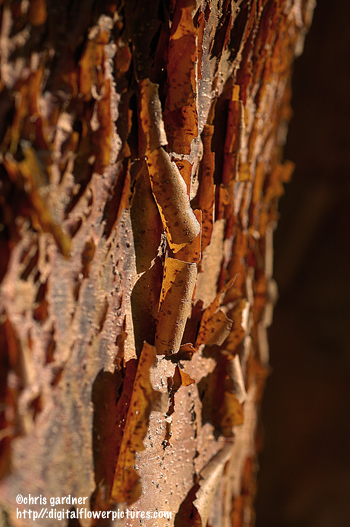
I could have used a little bit more depth of field on this photo. I probably also could have taken it nearer sunset when the setting sun lights up the peeling bark like fire. This is a fine little Maple for just about any garden setting. In addition to the beautiful bark, the fall color and the emerging new growth are all showy. It truly is a tree for all seasons as during the summer the green foliage is nicely shaped and remains clean and handsome looking. I have seen the oldest and probably largest specimen of Acer griseum in the United States. It is located at the Arnold Arboretum in Boston. The famous plant collector Ernest Wilson discovered the tree on a trip to China and the Arboretum introduced the tree to North America in 1907. Funny thing about the old specimen was that the trunk had turned a kind of a sunburned color and most of the flaky parts were high in the air. So I actually enjoy a smaller specimen where the exfoliating bark is closer to the ground. My Paperbark goes well in a part shade but the tree can take full sun (in this area). It can grow in moist areas but mine is located in a fairly dry area. Basically it is not a real fussy tree. It had to get transplanted after about 5 years of being planted to get some pipes through the area. That was 7 years ago and while that slowed it down it is still growing strong.

Wednesday, November 08, 2006

Avalanche Birch (Betula x 'Avalzam')


Avalanche Birch
Betula x 'Avalzam'
(BET-yoo-luh)

This White Birch was growing in the Rock Garden at the New York Botanical Garden. Of the 120 plus plants I have researched for this blog this is the only one that the species was unknown. I saw it listed as European White Birch, Paper Birch and Asian Birch. The best information came from: http://members.tripod.com/~Hatch_L/betu77.html
(Sorry but I still haven’t figured out how to put a clickable link in these posts.) I found that website an excellent source for Betula information. Anyway, it says Storrison-Harrison Nursery brought the tree to the US from Japan in the 1930's. It also said the that it gets 50 feet tall and 30 feet wide, which sounds about right for the tree I saw. It is considered to have higher than average resistance to Bronze Birch Borer. I gave up on White Birch a while ago. I won’t plant it unless the customer ‘has’ to have it. There are just too many cultural problems associated with it. I did recently plant some Purple Leaf White Birch in a purple garden I built. They get treated with Merit every year. I will always try and plant a River Birch these days although if the opportunity arose to use a White Birch I would probably chose this one. The bark was white but had some peeling spots that showed some pinkish underneath. You can tell its getting late in the season when I am shooting pictures of bark.

Sunday, November 05, 2006

Birch Bark Cherry (Prunus serrula)


Birch Bark Cherry
Prunus serrula
(PROO-nus)

Yesterday I had to clear out of here. There was some construction going on at the house and thankfully I wasn’t involved in any of the decisions so I slipped down to the Bronx and the New York Botanical Garden. I went in the afternoon, which was totally different, then my usual morning visits. The gardens were beautiful and I always get a special feeling when I go into the garden. They still had a lot of foliage left compared to Connecticut. I guess that 50 miles makes a big difference. I visited the Enid A. Haupt Conservatory and they were still tearing down some of the Chihuly show. I pretty much had the place to myself. I got a couple of nice pictures of the tropical before moving on to the Ladies Border and garden in front of the Conservatory. There were still quite a few flowers left. I then headed over to the Rock Garden.

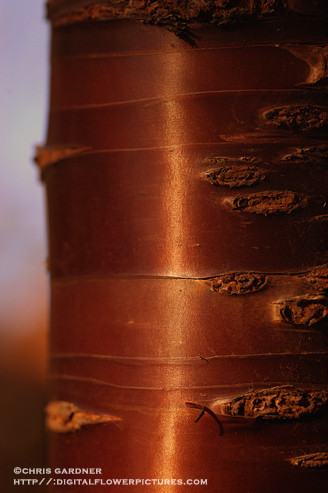
The Rock Garden is a truly amazing place. I am always in awe of the stuff I see in there. The Birch Bark Cherry was nicely highlighted by the setting sun. The bark is outstanding on this tree. I am not sure why you don’t see more often. It stays small (for a Cherry) and the white flowers are outstanding. It is has good fall color also. The bark has a metallic appearance when the sun is shining on it.

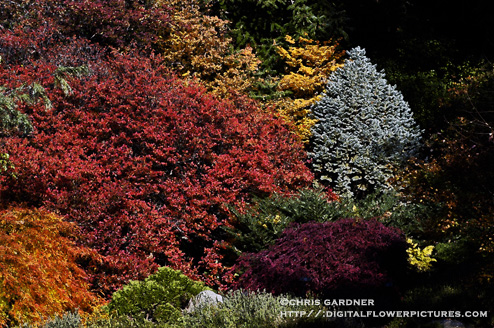
I saw one scene in the Rock Garden that pretty much struck me dumb when I came around the corner. It certainly was some of the best fall foliage I saw this year. I took this picture but it didn’t come out very well. As I was standing there with my puny digital camera I knew it could never capture all the color, especially without a tripod. It is one of the few times recently that I longed for a film camera. I ran this photo through the watercolor filter in PS because it was a little soft. The multi-layering of the different colors and the touch of evergreen were just right. The Rock Garden is always full of surprises and it didn’t disappoint.

(Syn.: Paper-bark Cherry, Tibetan Cherry)