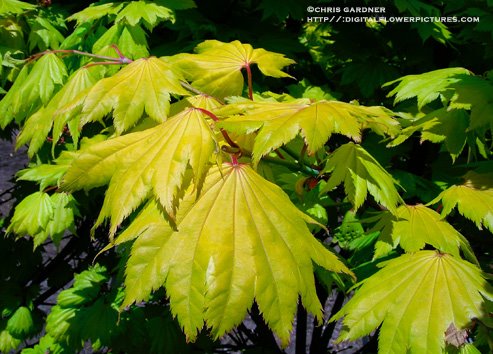
Fernleaf Fullmoon Maple
Acer japonicum ‘Aconitifolium’(AY-ser) (juh-PON-ih-kum)
Synonyms: Maiku jaku, Downy Japanese Maple, ハウチワカエデSince I have been enjoying all the Japanese Maples at work and posted on other blogs,
like Ki’s, I thought I would share one of my favorite trees. The term Japanese Maples is usually applied to
Acer palmatum but this tree is actually a species (different second name)
Acer japonicum and it is a cultivar of that species ‘
Aconitifolium’. Other cultivars of this tree include '
Vitifolium' and ‘
Green Cascade’. It is a wonderful small stature tree that can grow in partial shade (should be in hot climates) and is hardy to USDA Zone 5. The species was introduced to the United States in 1864. Golden Fullmoon Maple is actually a different species
A. shirasawanum. I did a post on that tree
here.A good way to tell the difference between
Acer palmatum and
A. japonicum is the amount of lobes on the leaf. The
palmatum types usually have seven or less lobes and
japonicum has 9 to 13 lobes. Sorry if all those species are confusing it kind of breaks down like this.
Acer palmatum and
Acer japonicum are both species of Maple. They are both commonly referred to as Japanese Maples. The species of
A. japonicum further breaks down into cultivars of Fernleaf (‘
Aconitifolium’), Grape-leaved '
Vitifolium' and Weeping (‘
Green Cascade’).

The Estate has two specimens of Fernleaf Fullmoon Maple. One is planted in a shady location and the other is in full sun. These pictures are from the sunny one. The one in shade grows a bit sparser and slower and gets more of a yellowy fall color. It is still beautiful. Most of the trees at work are tagged as to what they are, where they bought and how big and when they were planted. This one was bought at Imperial Nurseries, came in a 15 gallon container and was planted in the summer of 2000. As I remember it was about 5 feet tall and had a spread of about 4 feet. In the last seven years it has grown to about 8 feet tall and is about 12 feet wide. Its final height is supposed to be 10-12 feet tall and 15 feet wide but I have seen larger ones. The flowers in the spring and the emerging foliage (sometimes with a touch of pink) are beautiful as are the large green leaves in the summer. The real show starts in the fall with the change to orange, yellow and red leaves. The autumn show lasts quite a while and after the leaves fall off the winter outline isn’t bad looking. So it is really a tree that has three strong seasons.
The first picture was shot with the 60mm/2.8 Micro-Nikkor and on the second ahot I used the 50mm/1.8 Nikon lens.