Showing posts with label Ilex. Show all posts

Thursday, February 07, 2008

Golden Nellie R. Stevens Holly

Hybrid Holly
Ilex x cv. 'Gold Nellie R. Stevens'
(EYE-leks)

One of things I enjoyed at Planting Fields was their huge Ilex collection. Both in the scope and size of the plants. This cultivar is one type I had never seen before, and realize that it is not for everyone. The regular or normal Nellie Stevens Holly is a beautiful shrub or tree but it doesn’t grow well in my part of Connecticut. I would say about 6 out of 10 winters it is severely leaf burned and it sustains some damage 8 out of 10 years. Even though mine are planted in a sheltered location the constant winter defoliation has been taking its toll. It doesn’t actually kill the tree but makes more of a semi-evergreen, which kind of defeats the purpose of having a Holly. It seems these problems also effect the berry production as I have only had a few scattered berries in the 18 years I have been growing mine even though there are plenty of males around.


Now on Long Island they seem to thrive and are not as affected by the winter. They can attain a height of 15 to 25 feet (or more) and get a large spread. It can be quite vigorous and adaptable, growing several feet in one season. Although many books list it being hardy in USDA Zone 6 I would have to add that it is root hardy but does much better in Zone 7. It is a hybrid between I. cornuta x I. aquifolium and I couldn’t find any references to the gold cultivar.

Yellow berries on American Holly Tree (Ilex opaca f. xanthocarpa)

I have been trying to get a picture of the yellow berried form of the American Holly Tree for a long time. Mine don’t seem to get a great crop of berries and are located in a dark corner of the garden, hence difficult to shoot pictures of. I didn’t do much better at Planting Fields with this picture but they had a lot of different specimens that were loaded with yellow berries. So, I am posting this picture of Ilex opaca f. xanthocarpa to get it out of my system. This will hopefully allow me move on and get that picture of Lily of the Valley flowers I have been trying to take forever.

There several yellow berried cultivars of American and other Hollies. I think they add a little spice to a Holly collection.

Monday, January 14, 2008

Fragrant Wintersweet Tree

Fragrant Wintersweet Tree
Chimonanthus praecox
(ky-moh-NAN-thus) (pray-koks)
Calycanthaceae

Thinking I would enjoy the last day of moderate weather I went down to Wave Hill Gardens in the Bronx. What a wonderful winter walk I had around the gardens. I found this plant, Chimonanthus praecox, in full bloom. It didn’t look like a sporadic bloom but it was doing what it did every year at this time. Its translucent yellow flowers were highly fragrant and in various stages of blooming. I can’t really report what it is like to have this plant in the garden but after looking it up I will have to give it a chance. I found out it hardy to USDA Zone 6 and grows to 12 to 15 feet tall. It was planted in a protected location at Wave Hill and I will probably do the same with mine. The only negative thing my research turned up is that it can sometimes take several years to bloom. Since I have learned that you really need to have patience in the garden that wouldn’t really bother me.


I will be featuring some of the plants that I saw at the gardens this week. This was a particularly pleasing combination of Winterberry Holly (Ilex verticillata), Inkberry (Ilex glabra) and although you can’t see it here a low-growing gray Juniper. Winterberry has been featured on this blog before and if you want more information on it click the label for this post. This was the species, which has slightly smaller berries that are spaced a little further apart than most of the cultivars. The species can be variable though.


Yesterday I also went to get shoes. Not that remarkable for most people but when you wear size 16 EE it is always an adventure and sometimes a nightmare. I had heard of a shoe store that was carrying sizes like that and I walked in and quickly scored three pairs at 30% off. Oh happy joy! If I could find a clothing store like that I would be really happy.


Thankfully the snowstorm only dropped 4 inches instead of the forecast 15. The weatherman can be wrong like that every time as far as I am concerned.

Sunday, November 04, 2007

Sparkleberry Holly


Sparkleberry Holly
Ilex x ‘Sparkleberry’

This is an interesting deciduous Holly that I have been growing for several years. I always thought it was a cultivar of Winterberry Holly but after looking it up I found out that it is a cross between Finetooth Holly (Ilex serrata) and our native Winterberry or Black Alder (Ilex verticillata). According to my research ‘Sparkleberry’ was the result of a controlled cross between the two plants in 1961 by William Kosar. It came out of the National Arboretum’s plant breeding program with the desire to have the I. serrata’s heavy fruiting characteristics and the adaptability and larger berry size of the Winterberry. From my point of view they were extremely successful.

I have my plants on the edge of the woodland in full sun. They can also tolerate part sun and very wet sites. Although you will get more berries when they are planted in full sun. I don’t have the male pollinator ‘Apollo’ that was developed at the same time. I do have several other male winterberries and have not had a problem with getting fruit on my ‘Sparkleberry’. It just requires a male of either species. These shrubs do get up to about 12 feet tall with a fairly large spread so they need a little room. I prune mine lightly whenever they need it to maintain a nice shape but basically they are very low maintenance. They are hardy to UDSA Zone 5b.


Since when I featured the ‘Little Boo’ white pumpkins on Wordless Wednesday a lot of people wrote that they had never seen a white pumpkin before I thought I would post this image of a full sized one. I took it at the same time as the other picture. I don’t know what variety this is but it much more like a normal sized pumpkin than the ‘Little Boo’, which you can see in the left side of the picture.

Wednesday, October 31, 2007

ABC Wednesday ~ ‘Scarlett O’Hara’ Winterberry Holly


ABC Wednesday ~ ‘Scarlett O’Hara’ Winterberry Holly

Winterberry Holly
Ilex verticillata ‘Scarlett O’Hara’
(EYE-leks) (ver-ti-si-LAH-tuh)
Synonyms: Black Alder

This week brought a wealth of ‘O’ photos. I actually had a few extra that I didn’t use. Those will probably be popping up here and there over the next few weeks. I am the only one that is thinking about next week’s letter right after this post? ‘P’ should be easy. I am thinking of something already.

We pretty much wrapped up the gardening season here this week. Both Monday and Tuesday featured killing frosts. In one way I am sorry to see it go, in another it was a fairly terrible season to grow things around here. We had a late Spring, cool summer, drought in late summer early fall and all that really didn’t add up to a great growing season. I guess some plants liked the conditions and flourished and some didn’t and didn’t do well. All in all Connecticut’s climate is fairly amazing because of the amount of plants that find the conditions to their liking during the season. It is a broad based bunch that hails from around the world. This year a lot of things didn’t thrive like they have in the past. In general I would give the year a 6 out of 10 and that maybe a little generous. As a gardener though I am pretty much an eternal optimist and will be out there again next year, with high hopes.

‘Scarlett O’Hara’, which is of course named after the heroine from ‘Gone with the Wind’, is a deciduous Holly. The plant has become quite popular and there are numerous named cultivars available. I hadn’t seen this one before but have been growing some of the others like ‘Winter Red’, ‘Sparkleberry’ and the smaller growing 'Cacapon' and ‘Red Sprite’. The cultivars are better than the species in almost every case. This Northeastern United States native likes moist soil and can grow in wet areas. It also can grow on drier soils but I like to use it in tough areas. The striking berries are really showy when the leaves fall off and the birds like them.


Oxalis vulcanicola “Molten Lava’

This ‘O’ is growing at work in the Conservatory. It is a funny little plant that flowers from time to time. The foliage color is interesting and it doesn’t seem to need much care. I just found out the foliage gets a deeper and richer color in the sun. I will have to move it. If you want to know more about the Wood Sorrels refer to this page of Oxalis.org

and the Wikipedia page on Oxalis


This last ‘O” is for ocular. I took this picture at a local nursery. When I went up there last week they already had the Christmas stuff out!


Here are some of the other blogs that are participating in ABC Wednesday. If you want to join let me know and I will add your link. I took out a few people that haven’t been posting the last couple of weeks. If you want to get back on the list leave a comment. We also have some new people and to them welcome!


Oh yeah, I am sure someone else though about this, ‘O’ is for Orange.

Monday, November 20, 2006

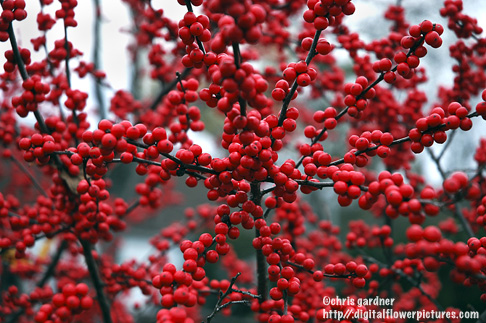
"Winter Red' Winterberry Holly


Winterberry Holly
Ilex verticillata 'Winter Red'
(EYE-lecks) (ver-ti-si-LAH-tuh)

My Winterberry Holly never seem to quite end up with as many berries as this specimen I saw at Rosedale Nurseries in Westchester County. I am not sure why, maybe because some of them are growing in part shade. Even if you don’t have this many berries it is still a nice plant to grow. On 10/21 I posted a shot of ‘Winter Gold’ Winterberry and they always seem to have a heavier crop of berries than my ‘Winter Red’. This is probably related to something I am unintentionally doing and I haven’t been able to figure it out.

I am not looking forward to this week. I have six days of work planned and only three days to do it. Last night when I took the garbage out there was a rain and snow mixture, and that doesn’t bode well for all the clean up and other work I have to do. I guess it is time to pay for all those nice temperatures we have been having the last couple of weeks.

Friday, November 17, 2006

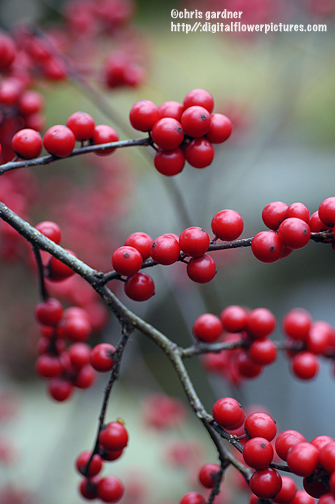
Possumhaw (Ilex decidua ‘Warren’s Red’)


Possumhaw
Ilex decidua ‘Warren’s Red’
(EYE-lecks) (dee-SID-yoo-uh)

This plant never fails to deliver a good crop of brightly colored berries. It is not exceptional during the summer but it isn’t bad looking either. ‘Warren’s Red’ was discovered as a sport at Otis Warren and Son Nursery in Oklahoma City. It grows much smaller than the species. Mine has been growing at the side of a man-made pond for several years so it tolerates wet soil. It is about 5 feet tall and 4 or 5 feet wide, which is smaller than the listed size. I never have had to prune it. It is growing next to a planting of Red and Yellow Twig Dogwood that didn’t turn out the way I wanted. As a matter of fact I decided to remove them yesterday. I hope to get a few more ‘Warren’s Red ‘ to replace them. It looks similar to Winterberry Holly but seems to hold its foliage a bit longer. It seems like it gets a heavier crop of berries every year, which my Winterberries don’t always do.


(Synonyms: Possum Haw Holly, Deciduous Holly, Ilex decidua var. curtissii)

Saturday, October 21, 2006

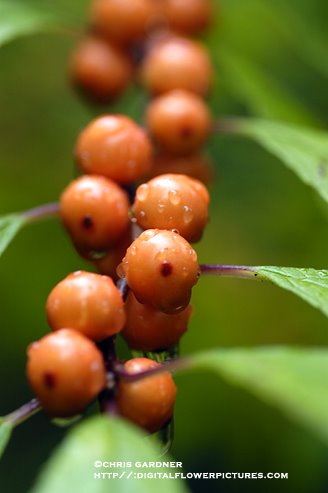
Winter Gold Winterberry Holly (Ilex verticillata 'Winter Gold')


Winter Gold Winterberry Holly
Ilex verticillata 'Winter Gold'
(EYE-lecks) (ver-ti-si-LAH-tuh)

I bought his plant as ‘Winter Gold’ although my friend swears it is sub-species of Winterberry that I have forgotten the name of. Whatever it is a great plant and adds a little zip to the Winterberry collection at one of the large gardens I take of. This plant is easy to grow and will tolerate moist to wet conditions. Most people’s first guess would not be holly because it is deciduous and spineless. I have been keeping ‘Winter Gold’ at about 6 feet though it seems to want to get a little taller. There is always a good crop of berries and the foliage remains clean throughout the season. I took pictures of some of the other Winterberry Holly that I will be posting next week.

I have to go out and see what last night’s high winds did to the gardens. Hopefully not too much but 50 miles per hour with a leaf load may have been too much. I am not sure why some of the color washes out on Blogger but these berries are a darker shade of orange!

(Synonyms: Black Alder, Michigan holly, Common Winterberry)

Saturday, October 14, 2006

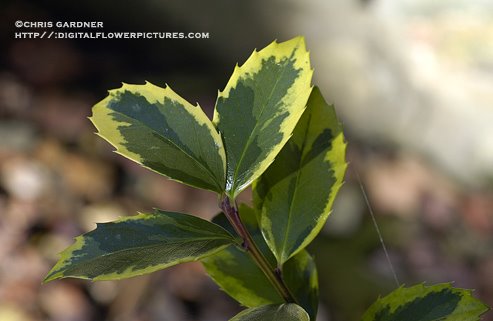
Variegated Blue Holly (Ilex x meserveae 'Honey Maid')


Variegated Blue Holly
Ilex x meserveae 'Honey Maid'
(EYE-lecks) (MESS-erv-ay)

This is a very unique and beautiful variegated form of the Blue Holly. I have been growing a Holly collection in one garden for years and this has been one of the nicest additions to it in a long time. It has been frustrating to cultivate the Variegated English Holly (I. aquifolium) in Connecticut. It does well for several mild winters then disaster strikes when we have a bad year and the winter winds and sun burn off most of the foliage. The English Holly seems to be on the edge of its hardiness range here and can look bad after a harsh winter. It appears to be stem and root hardy so if I use it is usually in a remote place that gives it time to recover. ‘Honey Maid’ on the other hand seems to have made through last winter okay, no damage. It was planted when dormant in late November and performed well all season. I have it in two different gardens and it continues to flourish in both places. I haven’t seen any berries yet but they are reported to be a nice red. Another nice thing about this plant is that it is generally smaller than most of the other Blue Hollies. I have been using a lot of dwarf ‘Blue Angel’ hollies in foundation and terrace plantings and that is also a winner. It grows very slowly but still has the charm of the bigger blues.
I would recommend ‘Honey Maid’ as an unusual accent plant.

Tuesday, August 29, 2006


Golden Foster’s Holly
Ilex x attenuata 'Sunny Foster'
(EYE-lecks) (at-ten-yoo-AY-tuh)

I saw this one at Polly Hill Arboretum on Martha’s Vineyard. Personally I love gold foliaged plants but I guess they are not for everyone. I think they look great as an accent and if used judiciously and sparingly they can add some drama to the garden. I haven’t grown this one personally so I am relying on information that I researched.

‘Sunny Foster’ was a leaf mutation of ‘Foster No. 2’ discovered in 1964 at the U.S. National Arboretum. The original ‘Foster’ Holly was part of a group of hybrids between Ilex cassine x Ilex opaca. It was released in March, 1982. It has nonmarginal variegation of yellow in the upper third of the leaf that deepens during the season. Planting in full sun intensifies this. The plant at Polly Hill was almost all yellow but the hint of green added a nice touch to the appearance. This plant is hardy in Zone 7 (USDA).

I wanted to thank the staff of the Arboretum for emailing with the identification of the plants that I asked about. They were really nice to take the time. The staff was very friendly while we at the garden also.