Showing posts with label holly. Show all posts

Monday, November 20, 2006

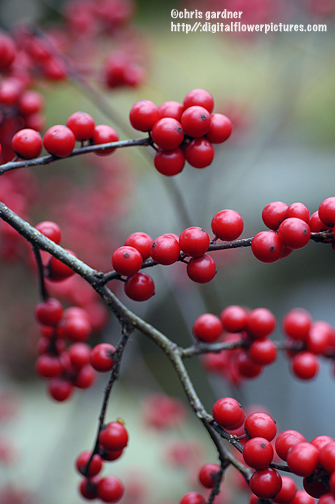
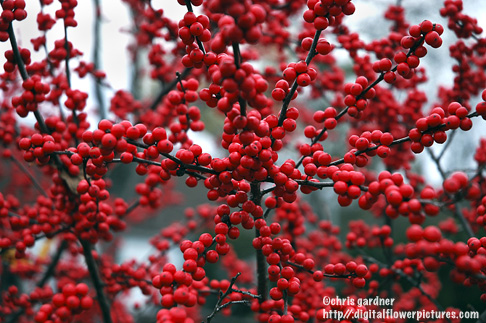
"Winter Red' Winterberry Holly


Winterberry Holly
Ilex verticillata 'Winter Red'
(EYE-lecks) (ver-ti-si-LAH-tuh)

My Winterberry Holly never seem to quite end up with as many berries as this specimen I saw at Rosedale Nurseries in Westchester County. I am not sure why, maybe because some of them are growing in part shade. Even if you don’t have this many berries it is still a nice plant to grow. On 10/21 I posted a shot of ‘Winter Gold’ Winterberry and they always seem to have a heavier crop of berries than my ‘Winter Red’. This is probably related to something I am unintentionally doing and I haven’t been able to figure it out.

I am not looking forward to this week. I have six days of work planned and only three days to do it. Last night when I took the garbage out there was a rain and snow mixture, and that doesn’t bode well for all the clean up and other work I have to do. I guess it is time to pay for all those nice temperatures we have been having the last couple of weeks.

Friday, November 17, 2006

Possumhaw (Ilex decidua ‘Warren’s Red’)


Possumhaw
Ilex decidua ‘Warren’s Red’
(EYE-lecks) (dee-SID-yoo-uh)

This plant never fails to deliver a good crop of brightly colored berries. It is not exceptional during the summer but it isn’t bad looking either. ‘Warren’s Red’ was discovered as a sport at Otis Warren and Son Nursery in Oklahoma City. It grows much smaller than the species. Mine has been growing at the side of a man-made pond for several years so it tolerates wet soil. It is about 5 feet tall and 4 or 5 feet wide, which is smaller than the listed size. I never have had to prune it. It is growing next to a planting of Red and Yellow Twig Dogwood that didn’t turn out the way I wanted. As a matter of fact I decided to remove them yesterday. I hope to get a few more ‘Warren’s Red ‘ to replace them. It looks similar to Winterberry Holly but seems to hold its foliage a bit longer. It seems like it gets a heavier crop of berries every year, which my Winterberries don’t always do.


(Synonyms: Possum Haw Holly, Deciduous Holly, Ilex decidua var. curtissii)

Saturday, October 21, 2006

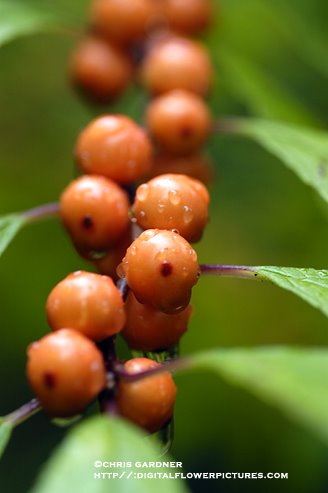
Winter Gold Winterberry Holly (Ilex verticillata 'Winter Gold')


Winter Gold Winterberry Holly
Ilex verticillata 'Winter Gold'
(EYE-lecks) (ver-ti-si-LAH-tuh)

I bought his plant as ‘Winter Gold’ although my friend swears it is sub-species of Winterberry that I have forgotten the name of. Whatever it is a great plant and adds a little zip to the Winterberry collection at one of the large gardens I take of. This plant is easy to grow and will tolerate moist to wet conditions. Most people’s first guess would not be holly because it is deciduous and spineless. I have been keeping ‘Winter Gold’ at about 6 feet though it seems to want to get a little taller. There is always a good crop of berries and the foliage remains clean throughout the season. I took pictures of some of the other Winterberry Holly that I will be posting next week.

I have to go out and see what last night’s high winds did to the gardens. Hopefully not too much but 50 miles per hour with a leaf load may have been too much. I am not sure why some of the color washes out on Blogger but these berries are a darker shade of orange!

(Synonyms: Black Alder, Michigan holly, Common Winterberry)

Saturday, October 14, 2006

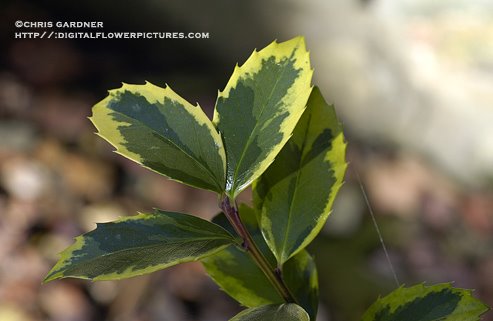
Variegated Blue Holly (Ilex x meserveae 'Honey Maid')


Variegated Blue Holly
Ilex x meserveae 'Honey Maid'
(EYE-lecks) (MESS-erv-ay)

This is a very unique and beautiful variegated form of the Blue Holly. I have been growing a Holly collection in one garden for years and this has been one of the nicest additions to it in a long time. It has been frustrating to cultivate the Variegated English Holly (I. aquifolium) in Connecticut. It does well for several mild winters then disaster strikes when we have a bad year and the winter winds and sun burn off most of the foliage. The English Holly seems to be on the edge of its hardiness range here and can look bad after a harsh winter. It appears to be stem and root hardy so if I use it is usually in a remote place that gives it time to recover. ‘Honey Maid’ on the other hand seems to have made through last winter okay, no damage. It was planted when dormant in late November and performed well all season. I have it in two different gardens and it continues to flourish in both places. I haven’t seen any berries yet but they are reported to be a nice red. Another nice thing about this plant is that it is generally smaller than most of the other Blue Hollies. I have been using a lot of dwarf ‘Blue Angel’ hollies in foundation and terrace plantings and that is also a winner. It grows very slowly but still has the charm of the bigger blues.
I would recommend ‘Honey Maid’ as an unusual accent plant.

Tuesday, August 29, 2006


Golden Foster’s Holly
Ilex x attenuata 'Sunny Foster'
(EYE-lecks) (at-ten-yoo-AY-tuh)

I saw this one at Polly Hill Arboretum on Martha’s Vineyard. Personally I love gold foliaged plants but I guess they are not for everyone. I think they look great as an accent and if used judiciously and sparingly they can add some drama to the garden. I haven’t grown this one personally so I am relying on information that I researched.

‘Sunny Foster’ was a leaf mutation of ‘Foster No. 2’ discovered in 1964 at the U.S. National Arboretum. The original ‘Foster’ Holly was part of a group of hybrids between Ilex cassine x Ilex opaca. It was released in March, 1982. It has nonmarginal variegation of yellow in the upper third of the leaf that deepens during the season. Planting in full sun intensifies this. The plant at Polly Hill was almost all yellow but the hint of green added a nice touch to the appearance. This plant is hardy in Zone 7 (USDA).

I wanted to thank the staff of the Arboretum for emailing with the identification of the plants that I asked about. They were really nice to take the time. The staff was very friendly while we at the garden also.